
One of the last great moments on the old algorithmic agora of Twitter, not long before it became the proprietary far-right organising tool “X”, was the Parliaments World Cup, a knockout competition. The idea was to rank every parliament building in every independent state in the world for its architecture rather than for the politics it embodied. The range was dizzying; yes, there were plenty of imitation Capitols and Westminsters, but there was also Slovenia’s elegant International Style box, the wild, expressive futurism of Indonesia and tropical modernism from Malaysia, to name some personal favourites. Inevitably, though, the grand finale was between modernism and traditionalism – in this case, between Bangladesh and Hungary. Both parliaments are officially known as “the House of the Nation”. The Jatiya Sangsad Bhaban in Dhaka, which began construction in 1961, is an elemental, minimal but monumental space designed by the Estonian-born American modernist Louis Kahn; Budapest’s Országház is a hulk of late 19th-century eclecticism draping a dome like that of the DC Capitol in Westminster-style Gothic details.
Hungary and Bangladesh have both recently held elections, but at the time of the cup final in 2020, it would have been a stretch to call either state a particularly healthy democracy. The contest was for fun, but with its mass participation and that particular balance of serious and not-serious that once made Twitter enjoyable and unpredictable, it led to real questions – what should building for popular rule actually look like? Are some spaces and some styles more conducive than others? Or is it all just a meaningless game of forms?
I thought of this contest many times on reading Jan-Werner Müller’s Street, Palace, Square, largely because these are the same questions asked by the Princeton-based German political philosopher – although, like the Twitter poll and its participants, he doesn’t give any definitive answers. He also begins his book in, and frequently returns to, Kahn’s Jatiya Sangsad Bhaban. As he points out, a coincidence meant that by the time the building – originally intended only as a provincial assembly for erstwhile East Pakistan – was actually completed, Bangladesh had achieved independence from Pakistan, leading to the Bangladeshi claim that, in some important if indefinable way, Kahn “gave us democracy”. By the time Müller visited the country for research, an urban insurrection had unseated the authoritarian government of Sheikh Hasina, and the security guards were having trouble adapting to a new ethos of openness.
This leads Müller to questions of history, ethics and built space, exploring which public spaces are, or are not, most suited for political contestation. The result brings together the themes of his previous books on democracy and on (mostly, right-wing) populism, along with something outside his usual purview – architectural and urban history. He spends as much time as he can on foot, and adds his own pleasingly inept snapshots, seemingly intended both to say “I was here” and to suggest what such places look like away from the flattering perspectives of conventional architectural photography.

At times, Street, Palace, Square resembles a conventional political history treatise – an essay in what Americans call “civics”. We begin, inevitably, with the Greeks and the Romans, and the ways in which their spaces for public assembly and, crucially, voting, differed. We find, unsurprisingly, that ancient Athens is far more evoked than emulated. When Athenian democracy was at its height, Müller writes, the agora – the marketplace that became the central point of meeting, debate and assembly – “was hardly beautified: it was not paved, it was filled with rubbish that Athenians simply dropped there; and, before the installation of latrines, one could see (and smell) plenty of excrement”. Over time “the space was also purposefully dignified, featuring monuments related to democracy”, such as the dual statue of the Tyrannicides, Harmodius and Aristogeiton. Actual legislation took place on a nearby hill, the Pnyx, “tightly packed together” in Greek, a natural amphitheatre that was, over time, provided with seats. It looked out over the city and the sea.
Most representative democracies, however, model themselves on the Romans and the forum of the republic, which was stuffed with monuments, crowded with touts and, for citizens, entailed a long single-file queue to vote, leaving the electorate subject to bribery and cajoling. It is a difference encapsulated here in a line by the Nazi legal theorist Carl Schmitt, the subject of Müller’s earlier book A Dangerous Mind (2003): “The Greek people’s assembly sat, the Roman stood! The difference between democracy and republic!”
However familiar, it’s welcome to find the ancient world discussed in its complexities and its sheer strangeness, rather than as the subject of “RETVRN” memes and decontextualised images of colonnades and pediments – and especially for the way the book shows that the freedom and democracy allegedly bequeathed by the ancients were inversely correlated with its degree of architectural grandeur. In ancient Rome, writes Müller, “the more crowded a forum became with monuments, the less it served as a place for political participation”. Accordingly, he holds a certain suspicion of architectural rhetoric and the notion that a political idea can be expressed in built form. The most egregious and common form of architects’ bullshit is, of course, the notion of “transparent” glass structures – all those glazed domes, from Norman Foster’s redesign of the Berlin Reichstag onwards – as incarnations of political openness and probity. This has always been nonsense. One of the first built examples of the idea, Giuseppe Terragni’s Casa del Fascio in Como, was literally designed for a fascist regime – and Müller enjoys taking it down for perhaps more pages than it really merits.
Müller quotes Winston Churchill’s assertion, on deciding to fund the rebuilding of the war-damaged House of Commons, that “we shape our buildings, and afterwards our buildings shape us”. I wondered if Müller was also aware of Aneurin Bevan’s memories of arriving as an MP from an industrial working-class town into Pugin and Barry’s neo-Gothic “mother of parliaments”, necessarily intimidated and cowed by its mass and opulence. Scale is sometimes more important than style, and one of the more interesting, unusual passages in Street, Palace, Square is on postwar West Germany’s severe suspicion of monumentality, which had been a fixation of Nazi Germany. In the West German capital, Bonn, the government buildings were examples of modest, almost domestic modernism, provocatively devoid of rhetoric or pomp, to a degree that annoyed a few German parliamentarians, who evidently considered that their work deserved more architectural bombast. But if “there is no uniquely democratic style”, according to Müller, then is there a uniquely democratic space?
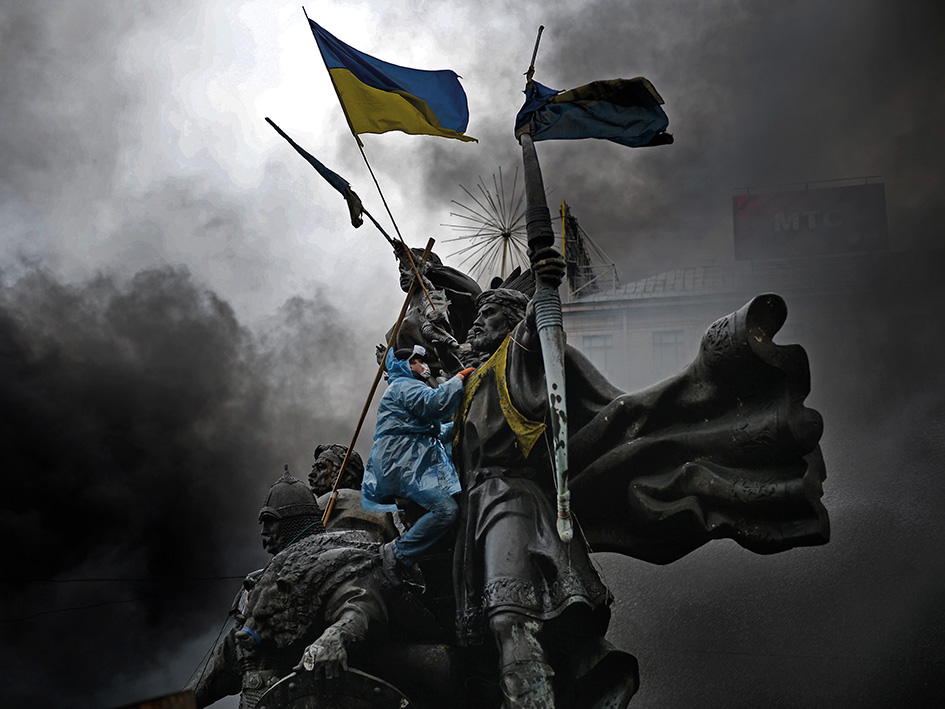
And here is where streets and squares come in. The Big Square as a political-spatial genre was especially popular in the cities of socialist authoritarian states, from Red Square in Moscow to Tiananmen in Beijing. Müller is somewhat dismissive of these, seeing them as mass politics turned into spectacle – maybe so, but they remain the places mass movements reach for in moments of crisis. Maidan Nezalezhnosti (Independence Square) in Kyiv, site of a series of urban revolts in 2004 and 2013-14, is little more than the Stalin-era October Revolution Square given a 2000s remodelling – an underground mall underneath and some sculptures of angels replacing Lenin. Here, Müller is better as an empiricist, reporting on the details of different places, than a general theorist of political space.
The contrast he draws between two spaces of the Egyptian Revolution of 2011 in Cairo is particularly instructive. There is Tahrir Square, centred around a monolithic 1940s government building, the Mogamma (which Müller, like many others, appears to think was in some way Soviet, though its original inspiration is more likely to have been American or French) – this was the everyone-welcome, non-sectarian carnival space of the revolution. And there is Rabaa Square, further from the centre, which was an organising space for the Muslim Brotherhood. When its candidate for Egyptian premier, Mohamed Morsi, was overthrown in a 2013 military coup, Rabaa was the site of a protest that was drowned in blood by the Egyptian army. Müller finds that today, neither space encourages lingering and congregation; he is told not to take pictures in each (advice he manages to ignore).
These restrictions, Müller rightly notes, are by no means limited to dictatorships like that of Abdel Fattah el-Sisi – they can also be found in the UK, with the extreme strictures on protest in the Public Order Act 2023, or the channelling of demonstrators into “zones” and “bubbles” of designated protest in the US. Although he remains sceptical about the idea of the street as inherently democratic, or as the space of urban accident (the last time you had a real conversation with a stranger was more likely, he argues, on the internet rather than on the street), he knows that governments still regard the freedom of the streets with suspicion.
The best and worst things about Street, Palace, Square come from Müller’s freshness in the subject. He has read widely, and though he is perhaps a little too credulous of some of the clichés of architectural and urbanist writing (we are referred once again to the claim that the New York mega-bureaucrat Robert Moses deliberately excluded working-class New Yorkers from his new Jones Beach by keeping the bridges too low for buses – something easily disproved by referring to the bus routes, both of the 1930s and in the present day), he looks at these spaces with an uncynical eye. If anything, I wanted more about the buildings, some thicker description to go with his wonky snapshots.
Müller’s argument seems at first to be leading him to advocate something along the lines of the anti-parliaments of radical architect and English utopian Cedric Price, who imagined a half-built, ad-hoc, anti-monumental parliament that would be much closer to the actual democratic culture of ancient Athens than anything that had Doric columns. In 1970s Sweden, such a space briefly existed when parliamentarians unable to use the old neoclassical Riksdag – then under renovation – were forced to hold sessions at the new South Bank-style Kulturhuset, stepping over children playing in the foyers and past recent Somali immigrants using the library, on their way to work as the people’s representatives. Müller eventually backs away from anything so radical, insisting that monumentality must remain important as a way of identifying and celebrating political space. In the end, it’s the book itself that feels full of potential – but rather unfinished.
Street, Palace, Square: The Architecture of Democratic Spaces
Jan-Werner Müller
Allen Lane, 272pp, £20
Purchasing a book may earn the NS a commission from Bookshop.org, who support independent bookshops
[Further reading: David Attenborough’s natural habitats]
Content from our partners


Related

This article appears in the 13 May 2026 issue of the New Statesman, Never-Ending Chaos
Join the debate
Subscribe here to comment